Pilbara
Iron Ore Capital of the World
Overview
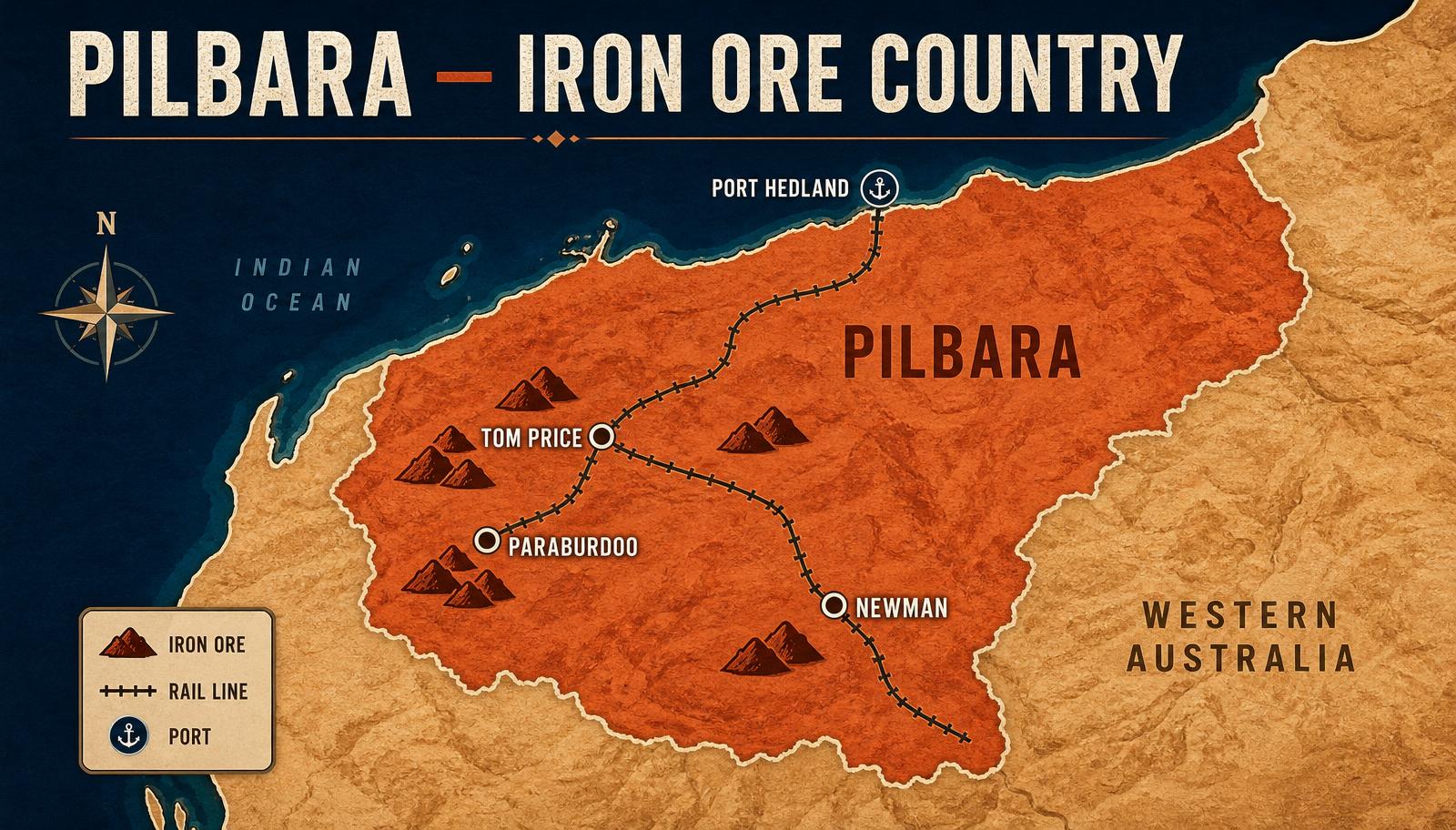
The Pilbara is Australia's Mining Powerhouse and by many measures the single most Productive Mining Region on Earth. Stretching from the Fortescue Marsh in the south to the De Grey River in the north, it produces more than 800 Million Tonnes of Iron Ore every single year — a volume so large it moves the entire global steel price. Every major inland town — Newman, Tom Price, Paraburdoo, Marble Bar, Nullagine — exists because of Iron Ore Mines that were carved out of the Hamersley Ranges from the 1960s onward. The four dominant operators (Rio Tinto, BHP, Fortescue and Roy Hill) run their own private rail networks to Ports at Port Hedland, Dampier and Cape Lambert, moving the ore hundreds of kilometres in trains that are among the longest in the world. Workforce structure here is dominated by FIFO from Perth on either 8:6 or 2:1 Rosters, with residential Roles concentrated in Newman, Karratha and Port Hedland where district allowances stack on top of base salaries. Entry-Level Operators regularly earn $110,000 to $150,000 per year and skilled trades $180,000 to $240,000 plus superannuation, accommodation, food and flights. Conditions are Extreme — summer temperatures routinely climb above 45°C and cyclones between November and April can shut sites down for a week at a time — but the money, the scale and the sheer speed of career progression are unmatched anywhere else in the country. If you are serious about a Long-Term Mining Career in Australia the Pilbara is where it happens.
- • Newman
- • Tom Price
- • Paraburdoo
- • Marble Bar
- • Nullagine
- • Onslow
- • Rio Tinto Iron Ore
- • BHP WAIO
- • Fortescue (FMG)
- • Roy Hill
- • Hancock Prospecting
- • Mineral Resources
- • Atlas Iron
- • Iron Ore
- • Salt
- • Manganese
- • Lithium (emerging)
Geology & Resources
The Pilbara sits on one of the oldest and richest banded iron formations on the planet — the Hamersley Group of the Hamersley Basin, laid down more than 2.4 billion years ago when the Earth's early oceans first oxygenated. The result is enormous, consistent, high-grade Iron Ore bodies (typically 58% to 65% Fe) that can be mined in massive open-cut pits with strip ratios low enough to justify the entire logistics chain to China, Japan and South Korea. Alongside the Iron Ore, the region hosts Salt operations at Onslow, Manganese at Woodie Woodie and rapidly-growing Lithium projects in the Ashburton, plus the North West Shelf natural gas province just offshore. The scale of the geology is why the Pilbara supports Tier-1 producers rather than junior explorers, and why individual pits routinely run for 30 to 50 years.
Who's Hiring — Major Employers
Four majors dominate. Rio Tinto Iron Ore operates 17 mines, four Port Terminals, a 1,700km rail network and the Perth-based Operations Centre that remotely runs the whole system. BHP Western Australia Iron Ore (WAIO) runs seven hubs across the Central Pilbara — including the Mt Whaleback pit at Newman, the largest open-cut Iron Ore mine on Earth. Fortescue (FMG) built its Cloudbreak, Christmas Creek, Solomon and Iron Bridge operations from a standing start in less than 20 years. Roy Hill, majority-owned by Hancock Prospecting, is the newest of the big four and one of the most modern. Below the majors sit Mineral Resources (Iron Valley, Wonmunna), Atlas Iron, and a rotating cast of Contractors — Monadelphous, NRW, Civmec, Downer, Programmed and CPB — who together employ tens of thousands of trades and construction workers on Shutdown and Capital-Projects work.
Lifestyle, Rosters & Living
Most Pilbara Workers Fly in and Fly out from Perth on Company-Chartered Qantas, Virgin or Alliance Flights, straight into camp airstrips at Newman, Paraburdoo, Cloudbreak and Christmas Creek. Standard rosters are 8-days-on / 6-days-off or 2-weeks-on / 1-week-off, though Trades often work 14:7 or 15:6 on Shutdowns. Camps are surprisingly modern — single rooms with ensuite, gyms, wet mess with cheap beer, cricket pitches, and a mess hall that runs 24 hours. Residential Workers in Newman, Tom Price and Karratha get a Housing Subsidy and Extra Location Allowance on top of Base Pay. Summer is brutal: 45°C+ days from November through March, plus Cyclone Season which can lock down sites for days. Winter (May–August) is genuinely pleasant — 25°C days, cold nights, huge night skies.
How to Get Hired Here
The Pilbara is Not the Easiest place to break in with Zero Experience — the Majors prefer proven Operators from Kalgoorlie, Bowen Basin or contractors with a Verified Track Record. The fastest realistic path is through Labour Hire Firms such as Programmed, WorkPac, One Key, Chandler Macleod and Skilled Group, who staff up entry-level Trades Assistants, Utility Operators, Cleaners and Camp Attendants for the majors. From there, Operators can progress to Haul Truck, Water Cart, Dozer and eventually Excavator or Shovel roles. Minimum Tickets are Standard 11 (or the WA-equivalent Site Induction), a Manual Driver's Licence, a Current Police Check, and a Pre-Employment Medical including a Functional Capacity Assessment and Drug and Alcohol screen. Trades need their Cert III plus any relevant HV switching or mobile-plant maintenance credentials.
Long-Term Outlook
The Pilbara is not slowing down. All four majors are Sustaining Capital Programs — replacement projects like Rio Tinto's Western Range and Rhodes Ridge, BHP's South Flank, Fortescue's Iron Bridge and Belinga, Roy Hill's Life-of-Mine extension — that will keep production above 900 Million Tonnes annually well into the 2040s. Alongside the Iron Ore, the Emerging Green-Iron and Green-Hydrogen projects on the Burrup Peninsula, plus expanding Lithium and Rare-Earth exploration, mean the demand for FIFO Trades, Operators and Construction Crews is expected to Grow, not shrink, over the next decade.