Where Mining Happens in Australia
From the Pilbara Iron Ore Belt to the Bowen Basin Coal Fields, the WA Goldfields, the Hunter Valley and Olympic Dam — Every Major Mining Region, Mapped and Explained.
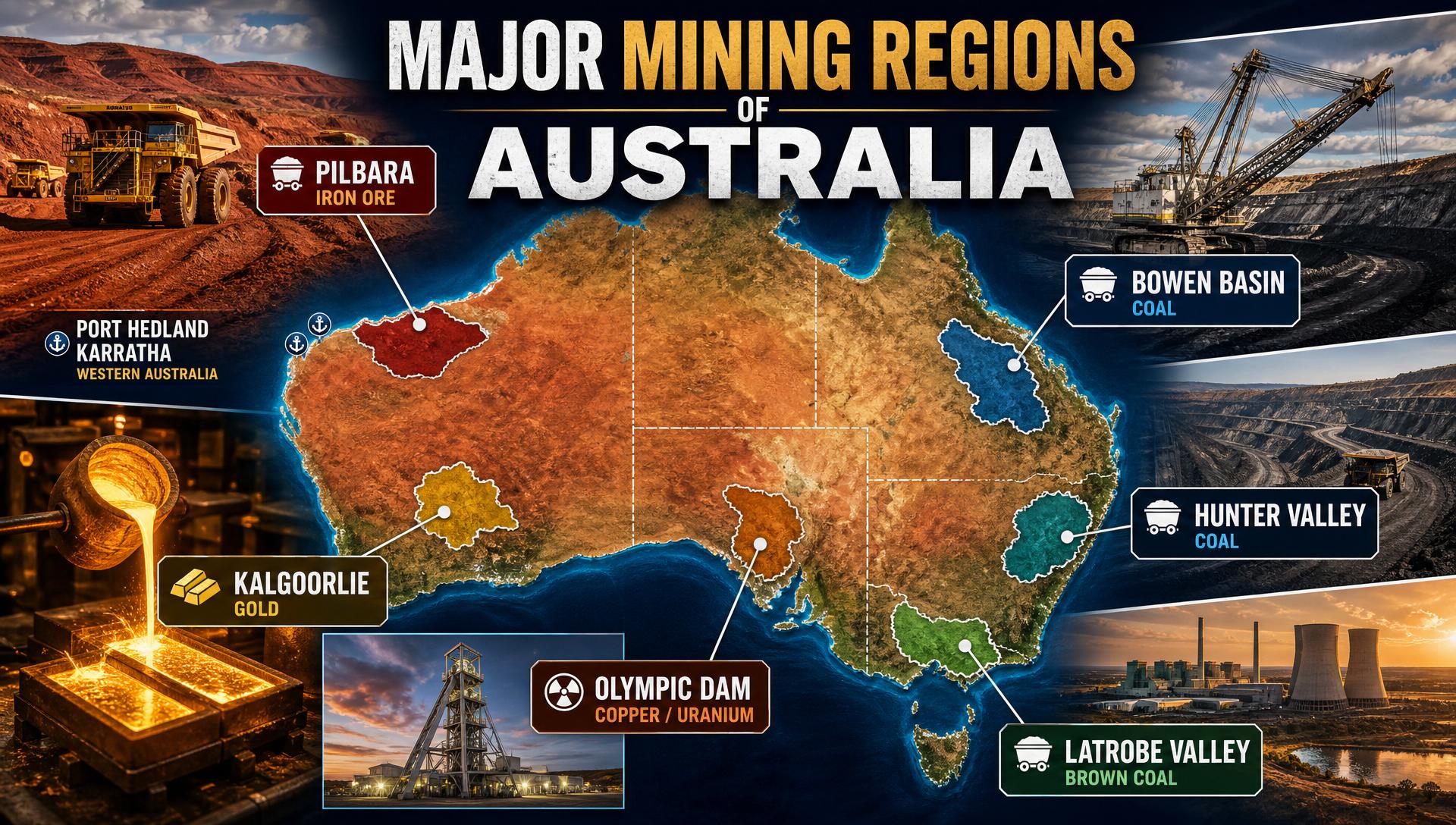
Major Mining Regions of Australia
Click any Region to open its Full Map, Employer List, Roster Guide and 800-Word Deep-Dive on Getting Hired.
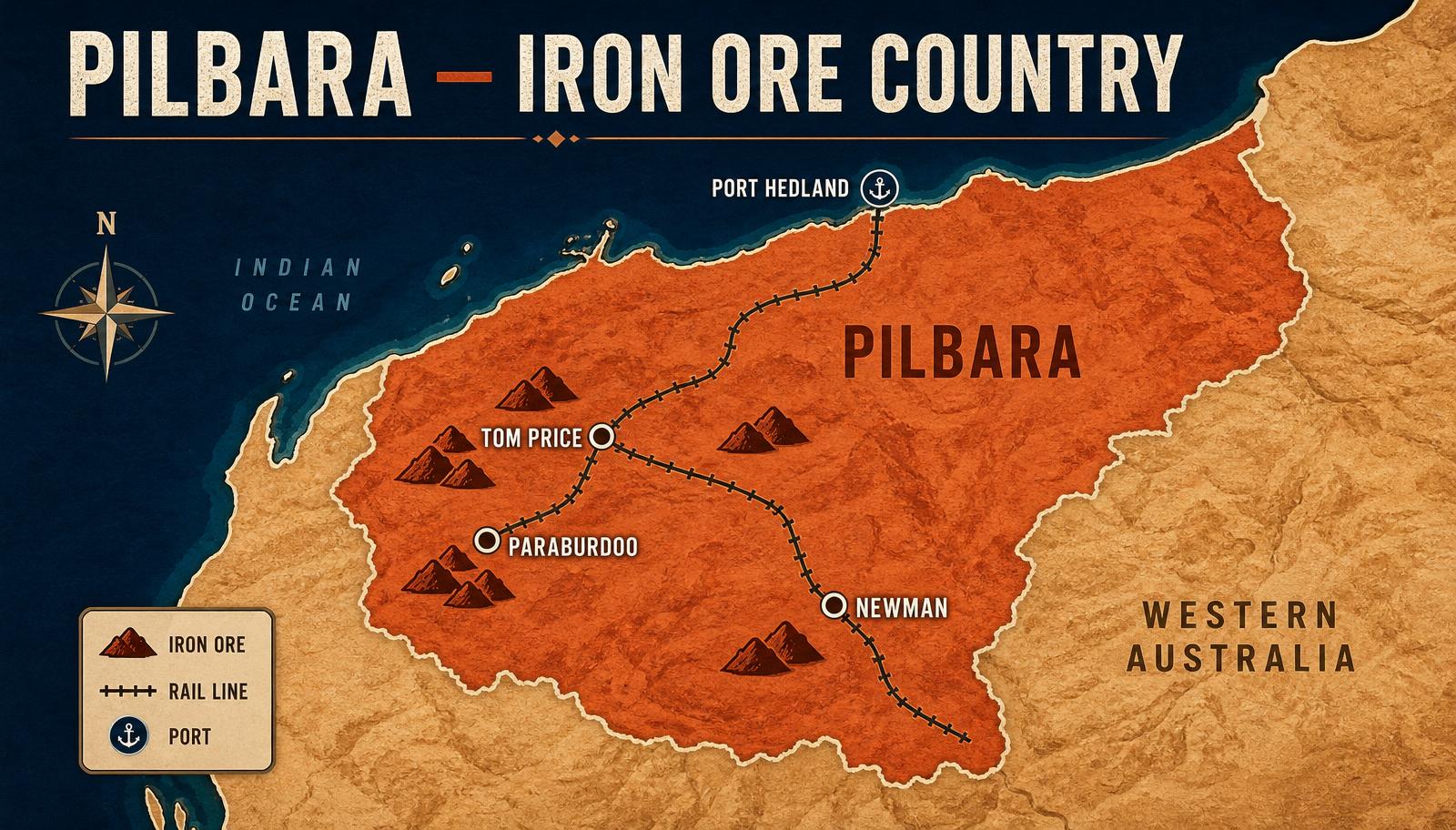
Pilbara
The Single Largest Concentration of Mining Employment on Earth. Over 800 Million Tonnes of Iron Ore railed to coast every year the Highest FIFO wages in Australia!
The Pilbara is Australia's Mining Powerhouse and by many measures the single most Productive Mining Region on Earth. Stretching from the Fortescue Marsh in the south to the De Grey River in the north, it produces more than 800 Million Tonnes of Iron Ore every single year — a volume so large it moves the entire global steel price. Every major inland town — Newman, Tom Price, Paraburdoo, Marble Bar, Nullagine — exists because of Iron Ore Mines that were carved out of the Hamersley Ranges from the 1960s onward. The four dominant operators (Rio Tinto, BHP, Fortescue and Roy Hill) run their own private rail networks to Ports at Port Hedland, Dampier and Cape Lambert, moving the ore hundreds of kilometres in trains that are among the longest in the world. Workforce structure here is dominated by FIFO from Perth on either 8:6 or 2:1 Rosters, with residential Roles concentrated in Newman, Karratha and Port Hedland where district allowances stack on top of base salaries. Entry-Level Operators regularly earn $110,000 to $150,000 per year and skilled trades $180,000 to $240,000 plus superannuation, accommodation, food and flights. Conditions are Extreme — summer temperatures routinely climb above 45°C and cyclones between November and April can shut sites down for a week at a time — but the money, the scale and the sheer speed of career progression are unmatched anywhere else in the country. If you are serious about a Long-Term Mining Career in Australia the Pilbara is where it happens.
- • Newman
- • Tom Price
- • Paraburdoo
- • Marble Bar
- • Nullagine
- • Onslow
- • Rio Tinto Iron Ore
- • BHP WAIO
- • Fortescue (FMG)
- • Roy Hill
- • Hancock Prospecting
- • Mineral Resources
- • Iron Ore
- • Salt
- • Manganese
- • Lithium (emerging)
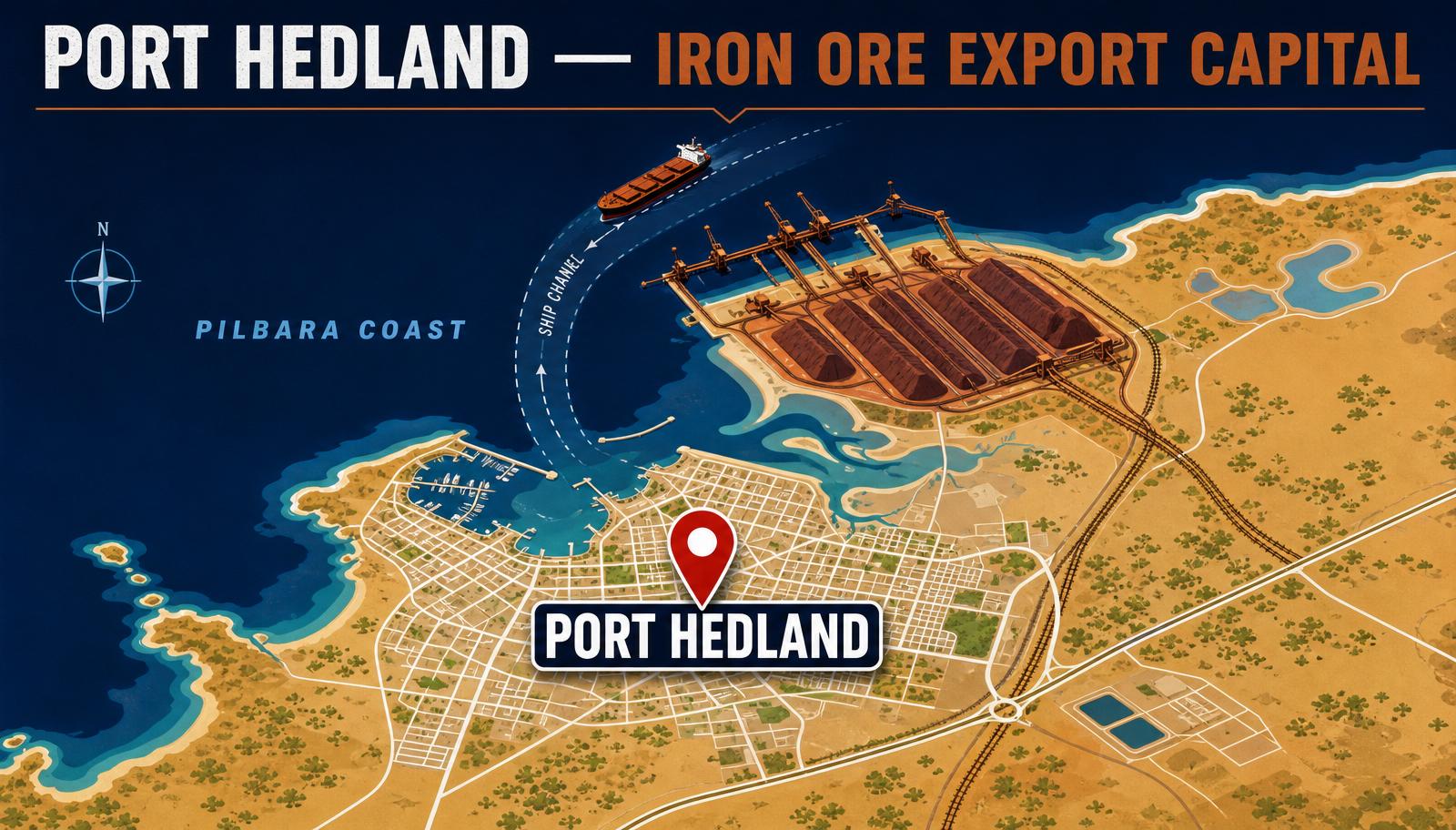
Port Hedland
Every second cargo ship of Iron Ore leaving Australia sails from Port Hedland. The town lives and breathes 24/7 export logistics — Cape-Size Vessels, Rail Unloading Loops and Stockpiles that stretch for kilometres.
Port Hedland is the single largest Bulk Export Port on Earth by tonnage. Over 550 Million Tonnes of Iron Ore, Lithium, Salt and Manganese flow through its Harbour every Financial Year — more than double Australia's next biggest port. BHP, Fortescue and Roy Hill each operate their own dedicated Rail Loops, Car Dumpers and Ship Loaders inside the Port, and Cape-Sized Vessels queue at anchor waiting for a tide window to depart through the notoriously narrow shipping channel. The town itself is split between the older Port Hedland township on the peninsula next to the water, and the newer South Hedland residential estate about 20km inland where most families live. Because of the concentration of Rail and Port Infrastructure, Port Hedland is a Powerhouse of Non-Site Mining Employment — Train Drivers, Rail Maintenance, Ship Loader Operators, Stockyard Machine Operators, Marine Pilots, Tug Crews, Port Control, Warehouse and Logistics. Residential Workers here receive one of the highest District Allowances in Australia on top of already premium mining salaries — a well-paid resi role commonly pays $180,000 to $260,000 including allowances, with subsidised Housing negotiated at hiring. Weather is Extreme — Cyclone Alley starts here — but the town has a strong community, a genuine sense of identity, and a lifestyle unlike anywhere else. If you can handle the heat and the isolation, Port Hedland is one of the highest-paying postcodes in Australia and one of the most reliable places to build a Long-Term Mining Career without living in a Camp.
- • Port Hedland
- • South Hedland
- • Wedgefield
- • Finucane Island
- • BHP WAIO
- • Fortescue (FMG)
- • Roy Hill
- • Pilbara Ports Authority
- • Qube Logistics
- • Rio Tinto (Cape Lambert nearby)
- • Iron Ore
- • Lithium concentrate
- • Manganese
- • Salt
- • Copper concentrate
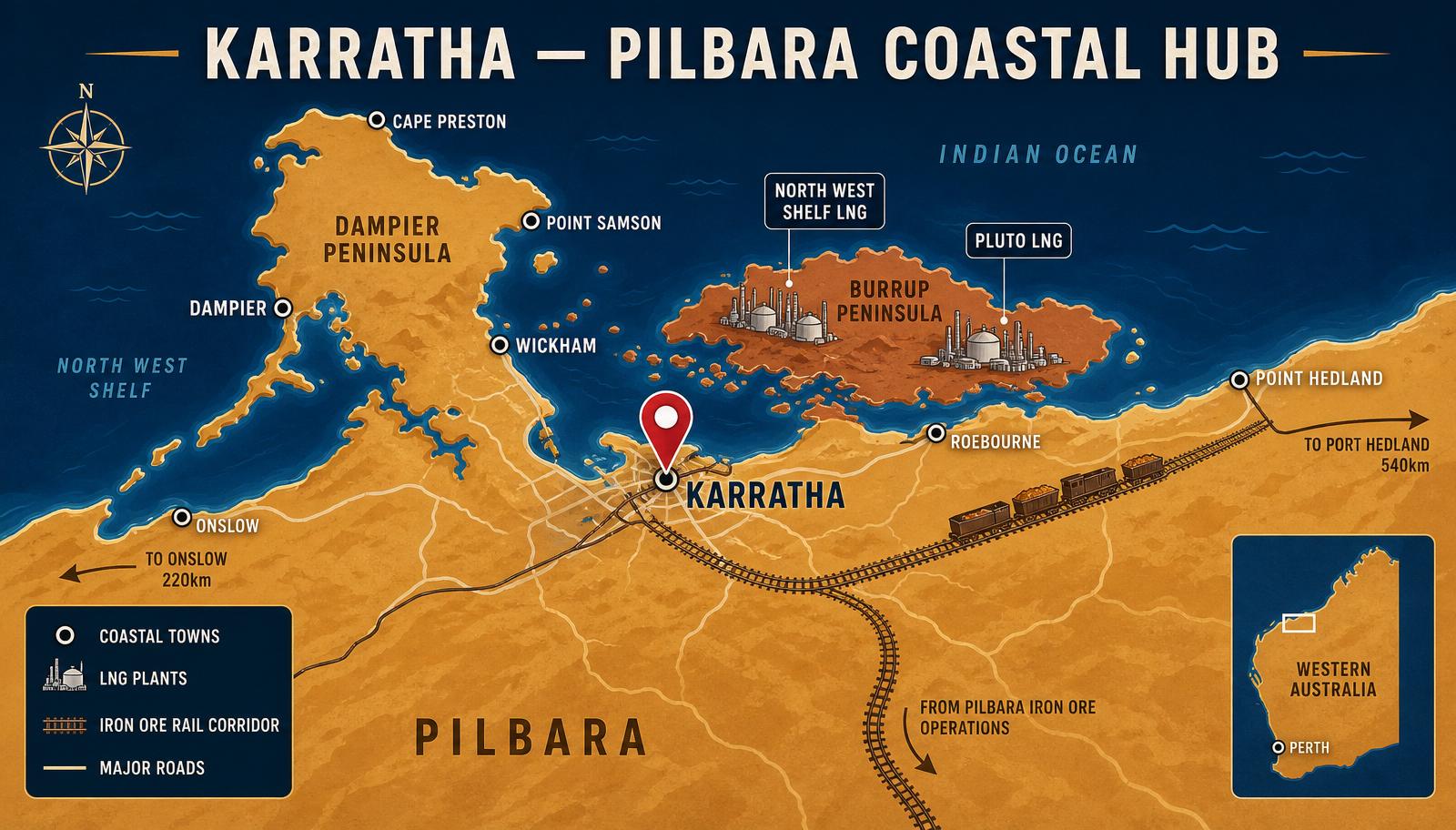
Karratha
Karratha is the Modern Face of Pilbara Life — Coastal, Family-Friendly, and home to both Rio Tinto's Iron Ore Ports and the biggest LNG Processing Plants in the country on the Burrup Peninsula.
Karratha is the largest Residential Town in the Pilbara and the region's Commercial, Family and Retail Hub. Sitting on the Coast about 1,600km north of Perth, it grew out of the Iron Ore and LNG booms of the 1960s and 70s to become a modern city of around 25,000 people with a full commercial CBD, a leisure centre, a private and public hospital, quality schools and dozens of parks. Employment in Karratha is unusual because it draws from two entirely different resource sectors at once. On the Iron Ore side, Rio Tinto operates its Dampier and Cape Lambert Port Facilities and moves ore in from inland Pilbara Pits at Marandoo, Brockman, West Angelas and Paraburdoo. On the Energy side, the Burrup Peninsula just north of town hosts Woodside's North West Shelf LNG Plant and Pluto LNG Facility — two of the largest Liquefied Natural Gas Processing Complexes on Earth — plus Yara Pilbara's Ammonia and Nitrates Plants and Chevron's Wheatstone Facility further west near Onslow. Karratha also supports Rio Tinto's Dampier Salt Operation, one of the largest solar salt fields in the world. The result is a Residential Workforce that includes Iron Ore Operators, LNG Process Technicians, HV Electricians, Instrument and Control Techs, Marine Crews, Mechanical Trades and Construction Workers — often earning $180,000 to $280,000 residentially with Housing Subsidy, District Allowance and Free Flights back to Perth for annual leave. Karratha is where families choose to live in the Pilbara.
- • Karratha
- • Dampier
- • Wickham
- • Point Samson
- • Roebourne
- • Rio Tinto Iron Ore
- • Woodside Energy
- • Chevron Australia
- • Rio Tinto Dampier Salt
- • Yara Pilbara
- • Iron Ore
- • LNG
- • Ammonia
- • Salt
- • Nitrates
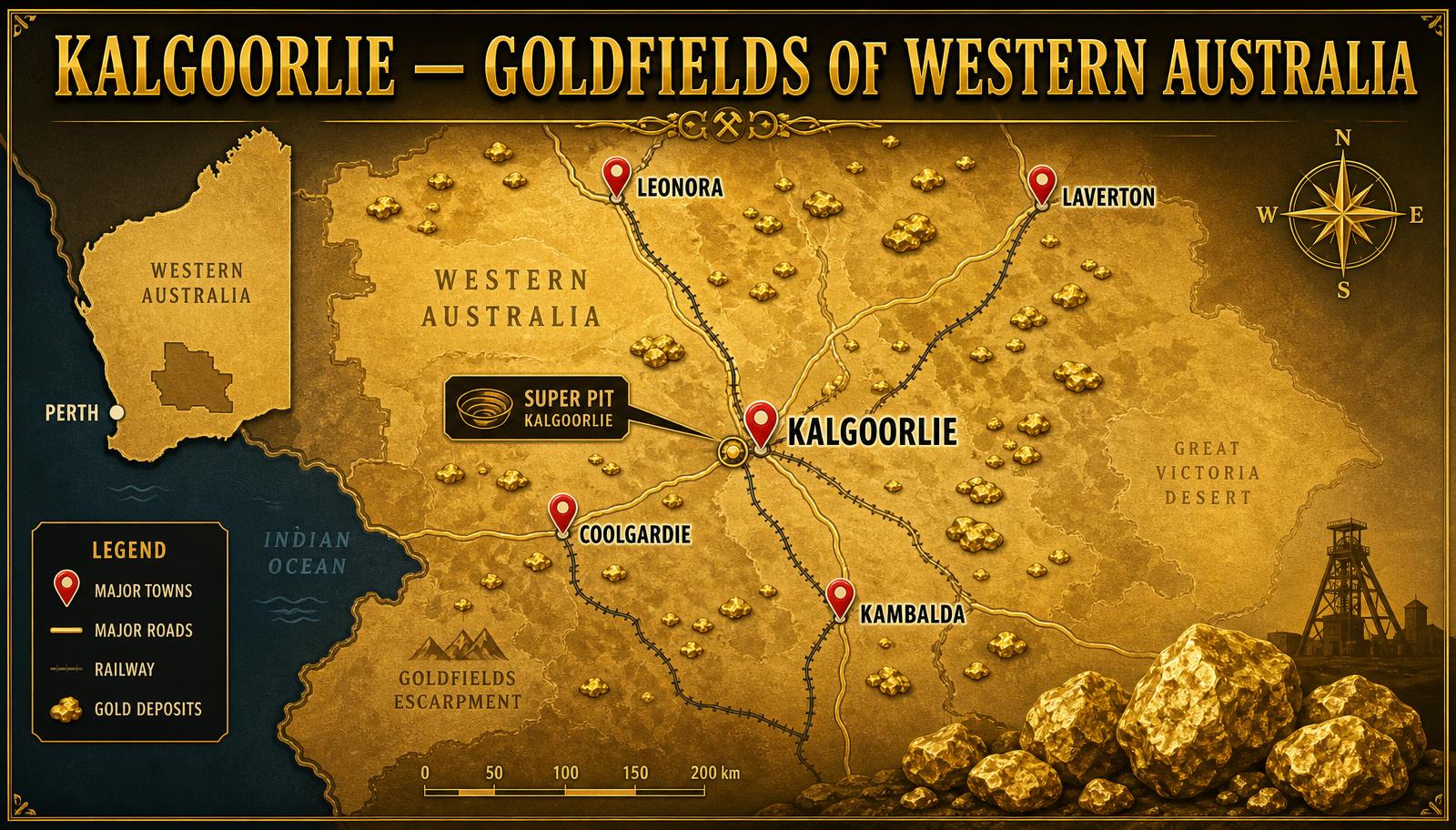
Kalgoorlie & the WA Goldfields
Kalgoorlie is the easiest place in Australia to Break Into Mining. Home of the Super Pit, dozens of Mid-Tier Gold Producers, and a growing Lithium and Nickel Cluster around Kambalda.
Kalgoorlie–Boulder is Australia's most famous Mining Town and the beating heart of the WA Goldfields. Founded on Paddy Hannan's Gold Discovery in 1893, it now sits on top of the Golden Mile — the richest square mile of Gold-Bearing Rock ever found — and hosts the giant Fimiston Open Pit (better known as the Kalgoorlie Super Pit) which is one of the largest open-cut Gold Mines on Earth. Beyond Kalgoorlie itself, the surrounding Goldfields stretch from Coolgardie in the south to Laverton in the north-east, and include Kambalda's Nickel Belt, the Leonora–Gwalia Gold District, and the fast-growing Lithium Cluster around Kathleen Valley, Mt Marion and Bald Hill. Because Kalgoorlie is a Residential Town of 30,000 people — not a Camp Site — the region supports a huge variety of Roster styles: 5:2 residential, DIDO from Perth, and traditional 2:1 FIFO for outlying operations. Crucially, the Goldfields are known as the easiest place in Australia to Break In With No Experience. Mid-tier producers such as Northern Star, Evolution, Ramelius, Silver Lake, Genesis, Gold Fields and IGO run smaller, more agile operations that will genuinely give a green candidate their first start — where the Pilbara Tier-1s tend to hire people who already have runs on the board. Entry-level Operators earn $95,000 to $130,000, Underground Operators and Truck Drivers $130,000 to $170,000, and Skilled Trades and Underground Airleg Miners $180,000 to $260,000 including Bonus and Site Allowances. Kalgoorlie is where most Australian Mining Careers actually start.
- • Kalgoorlie–Boulder
- • Coolgardie
- • Kambalda
- • Leonora
- • Laverton
- • Norseman
- • Northern Star Resources
- • KCGM (Super Pit)
- • Evolution Mining
- • Genesis Minerals
- • Gold Fields
- • Ramelius Resources
- • Gold
- • Nickel
- • Lithium
- • Silver
- • Copper
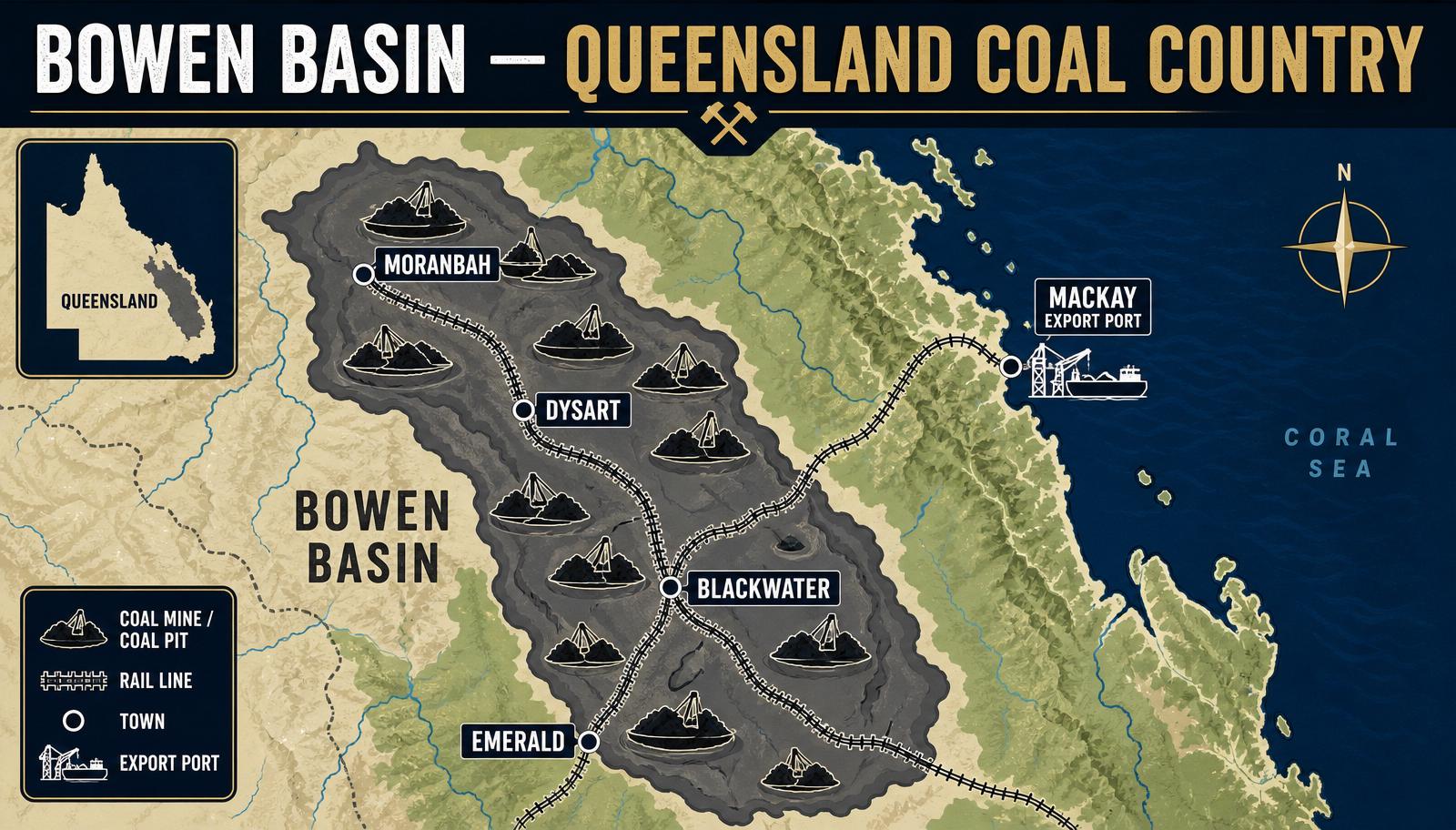
Bowen Basin & Mackay
The world's largest export source of High-Quality Coking Coal. Home to the BMA joint venture, Anglo American and Glencore — plus the tightest FIFO labour market in Australia.
The Bowen Basin runs 600km down the spine of Central Queensland and produces the majority of the World's Seaborne Metallurgical Coal — the specific type of Coal used to Make Steel. Coal from the Bowen Basin is railed east to the Coast and shipped through the Ports of Hay Point, Dalrymple Bay, Abbot Point and Gladstone to Steel Mills in Japan, South Korea, India and Vietnam. The Coalfields are anchored by BHP Mitsubishi Alliance (BMA) — the world's largest exporter of Seaborne Metallurgical Coal — plus Anglo American, Glencore, Peabody, Whitehaven, Coronado, Stanmore and Yancoal. Mining towns such as Moranbah, Dysart, Blackwater, Middlemount and Clermont are pure Mining Communities purpose-built for the industry, while Mackay on the Coast is the region's Family-Friendly Support Hub for Trades, Logistics and Engineering. Employment structure is dominated by FIFO from Brisbane, Cairns, Townsville and Newcastle on 7:7 or 5:2/4:3 rosters, with residential Roles concentrated in Moranbah and Mackay. The Queensland Coal Sector is different from WA Iron Ore in two important ways. First, entry is genuinely accessible — Standard 11 Generic Induction (RIIWHS204) is a 5-day paid Course anyone can complete before applying, and Labour Hire agencies actively recruit green Trades Assistants and Operators. Second, Wages are backed by legally binding Enterprise Agreements that push Operator base salaries into the $130,000 to $180,000 range and Skilled Underground and Trade Roles well beyond $220,000. Coal has been under political and financial pressure but demand for Coking Coal remains stubborn, and the region continues to hire aggressively.
- • Moranbah
- • Dysart
- • Blackwater
- • Emerald
- • Middlemount
- • Clermont
- • BHP Mitsubishi Alliance (BMA)
- • Anglo American
- • Glencore
- • Peabody Energy
- • Whitehaven Coal
- • Coronado
- • Metallurgical Coal (Coking)
- • Thermal Coal
- • PCI Coal
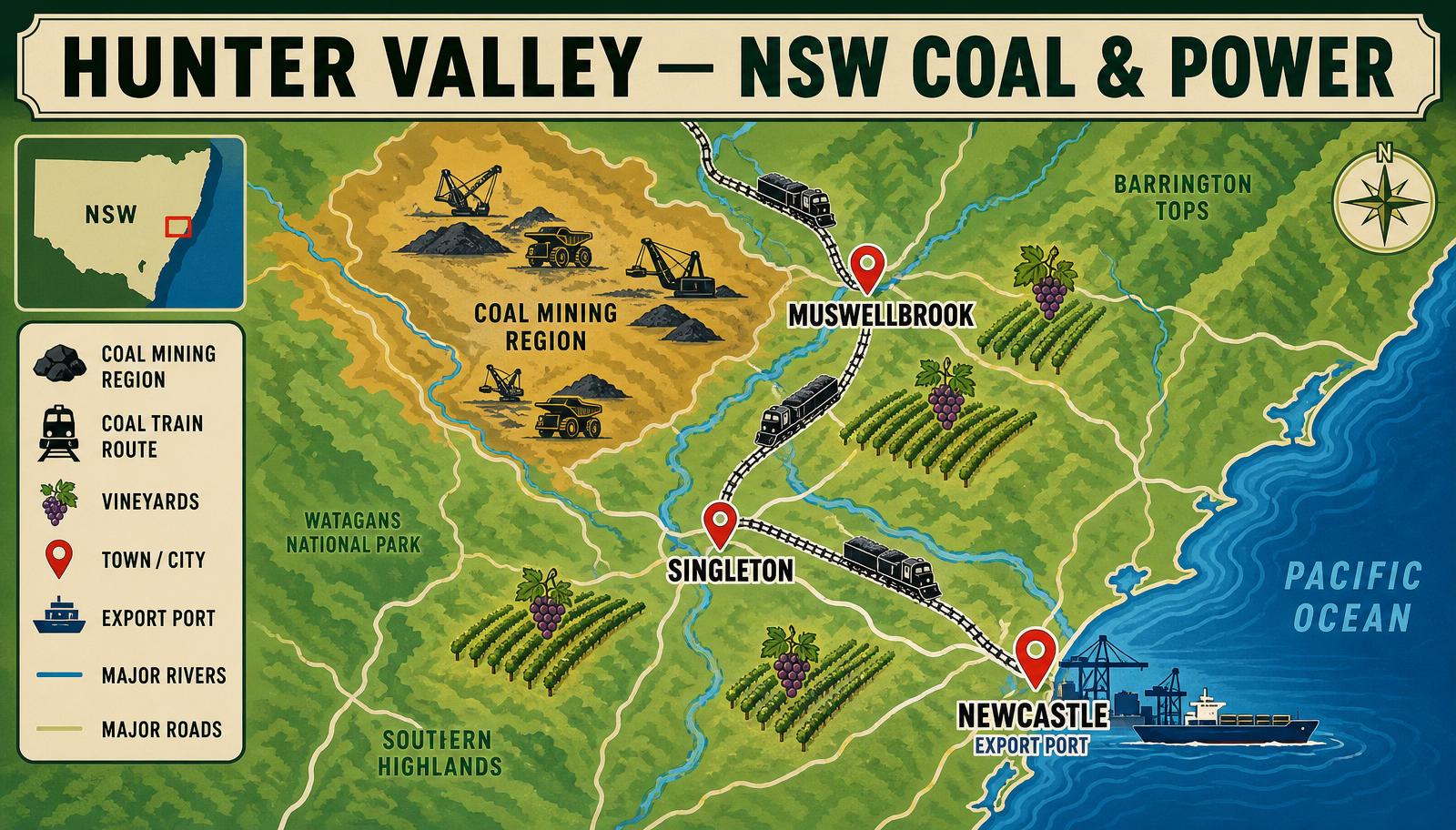
Hunter Valley
The Hunter Valley Coal Chain is the world's largest Thermal Coal Export System. Mining, Rail and the Port of Newcastle together employ tens of thousands within Two-Hours' Drive of Sydney.
The Hunter Valley is New South Wales' Mining Powerhouse and one of Australia's most Accessible Mining Regions to Live and Work In. Centred on Singleton and Muswellbrook, roughly a Two-Hour Drive North of Sydney, it produces around 160 Million Tonnes of Thermal and Semi-Soft Coking Coal a year — most of it destined for Power Stations in Japan, Taiwan, South Korea and Southeast Asia via the Port of Newcastle, the World's Largest Coal Export Port. The Region combines huge Open-Cut Operations (Mount Arthur, Hunter Valley Operations, Bengalla, Mount Pleasant, Mangoola, Bulga) with a smaller number of Underground Mines (Mandalay, Chain Valley, Tahmoor). Because it is a Drive-In Drive-Out region rather than a Fly-In Fly-Out region, most workers live within a 90-Minute Radius in Maitland, Cessnock, Muswellbrook, Singleton or Newcastle itself — meaning a Mining Career here comes with normal Family Life, City Amenities and Coastal Weekends. Wages are backed by strong Enterprise Agreements and are highly competitive: Operators earn $130,000 to $180,000, Underground Miners $180,000 to $240,000, and Skilled Trades comfortably $200,000+ with Bonus, Superannuation and Site Allowances. The Hunter is also arguably the best entry point for people transitioning out of Newcastle Manufacturing and Sydney Trades, because the Contractor Pool (Downer, Thiess, MACA, Golding, Fisher Cranes, Total Mining Services) is large and constantly hiring for Shutdowns, Dragline Maintenance and Overburden Operations.
- • Muswellbrook
- • Singleton
- • Denman
- • Scone
- • Newcastle (port)
- • Maitland
- • Glencore
- • Yancoal
- • Peabody Energy
- • Whitehaven Coal
- • Bloomfield Group
- • Idemitsu
- • Thermal Coal
- • Semi-Soft Coking Coal
- • PCI Coal
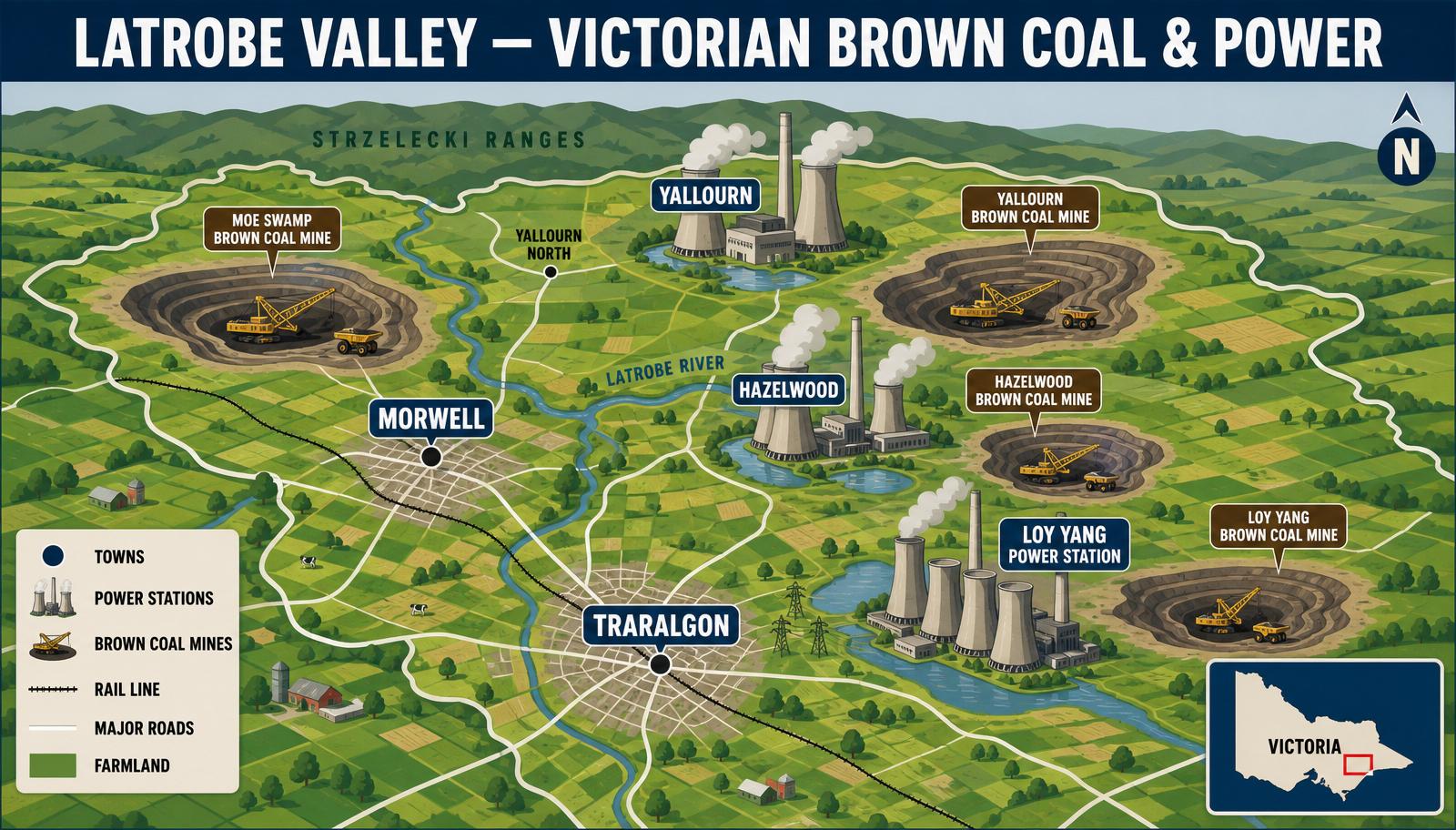
Latrobe Valley
Victoria's Historic Brown-Coal Power Belt is entering a Managed Transition. Massive Rehabilitation Projects, ongoing Power Station Operations and a Growing New-Energy Sector make this one of the country's most Interesting Mining Regions.
The Latrobe Valley in Eastern Victoria has powered the State for nearly a Century. Enormous Open-Cut Brown-Coal Mines at Yallourn, Hazelwood and Loy Yang have fed the adjacent Power Stations that historically supplied around 70 percent of Victoria's Electricity. Hazelwood Power Station and Mine closed in 2017. Yallourn is scheduled to close by mid-2028. Loy Yang A is scheduled to retire by 2035 under AGL's Updated Plan. What this means for Mining Employment is complex — and often misunderstood. The Latrobe Valley today is a Region in Transition rather than a Region in Decline. Alongside the Ongoing Operations at Yallourn, Loy Yang A and Loy Yang B, there is a Multi-Billion-Dollar Rehabilitation Program under way to Backfill and Rewater the retired Open-Cut Pits, plus Major New Energy Projects — Star of the South Offshore Wind, Marinus Link, Battery Storage, Hydrogen Trials — being sited specifically in the Region to Absorb the Skilled Workforce. Mining and Adjacent Employment Includes Dragline Operators, Bucket-Wheel Excavator Operators, Boilermakers, Heavy Diesel Mechanics, HV Electricians and Instrument Technicians. Wages are lower than the Pilbara or Bowen Basin — Victorian Coal is a Domestic-Only Product with No Export Premium — but the Lifestyle is unbeatable: 90 Minutes from Melbourne, low Cost of Living, No Camp Life and access to some of the best Alpine, Coastal and Wilderness Country in Australia. The Latrobe Valley is a Long Play for the Right Person: build a Career on Existing Operations, then Ride the Transition Wave into Rehabilitation, Wind, Hydrogen or Grid Infrastructure.
- • Morwell
- • Traralgon
- • Moe
- • Churchill
- • Sale
- • AGL Loy Yang
- • EnergyAustralia Yallourn
- • Alinta Energy (Loy Yang B)
- • ENGIE (former Hazelwood)
- • Ventia
- • Downer
- • Brown Coal (Lignite)
- • Power Generation
- • Rehabilitation
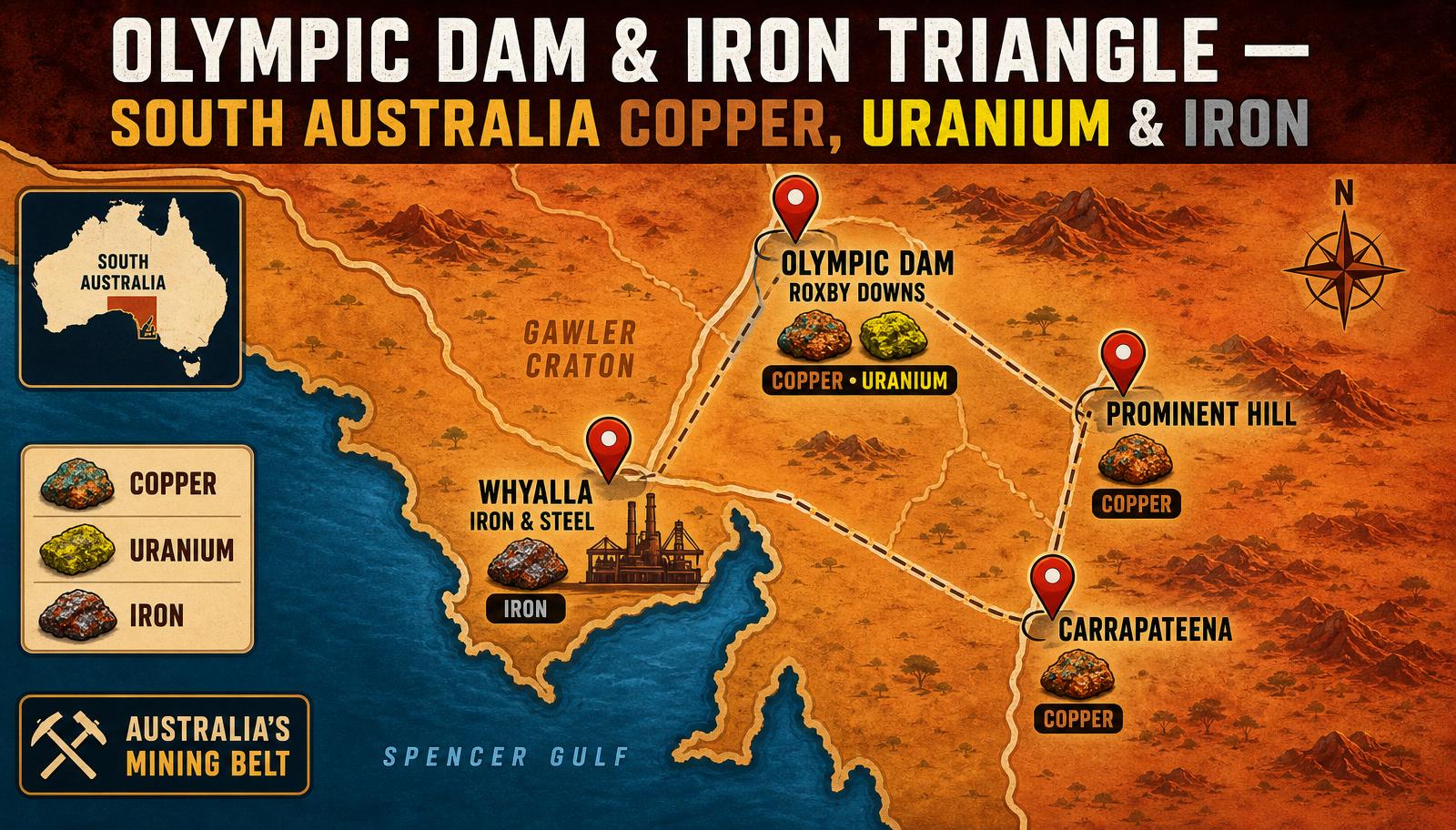
Olympic Dam & Iron Triangle
South Australia's Mining Belt is one of the most Geologically Diverse in the country — Olympic Dam is Uranium and Copper, the Iron Triangle produces Steel, and the Emerging Battery-Metals Sector is bringing significant New Employment.
South Australia's Mining Belt runs from the Spencer Gulf inland into the Outback and hosts some of the most Strategically Important Deposits on Earth. The Centrepiece is Olympic Dam — a huge Underground Copper–Uranium–Gold–Silver mine near Roxby Downs owned by BHP. Olympic Dam alone is the World's Largest known Uranium Deposit, the fourth-largest Copper Deposit and a significant Gold Producer, and it has been operating continuously since 1988. Nearby, BHP now also operates Prominent Hill and Carrapateena following its acquisition of OZ Minerals in 2023 — two more Copper–Gold Mines that together with Olympic Dam form the backbone of BHP's Copper SA strategy. On the Coast, the Iron Triangle around Whyalla, Port Augusta and Port Pirie is anchored by GFG Alliance's Whyalla Steelworks and Iron Ore Mining Operations at Middleback Range, plus Nyrstar's Port Pirie Multi-Metals Smelter — one of the largest Primary Lead Smelters in the world. Further west, Iluka Resources operates Zircon and Rare-Earth Mineral Sands Projects, and the Cooper Basin hosts a large Onshore Oil and Gas industry. The Employment Story here is Different again from WA or QLD. Roxby Downs is a Purpose-Built Company Town with excellent Facilities, Whyalla and Port Augusta are Established Regional Cities, and the Rosters are much friendlier to Family Life — typically 8:6 or 4:3 residential. Wages are Solid Rather Than Spectacular for Operators ($100,000 to $140,000), but Underground Mining and Skilled Trades earn $170,000 to $250,000 plus Bonus.
- • Roxby Downs
- • Whyalla
- • Port Augusta
- • Port Pirie
- • Coober Pedy
- • BHP Olympic Dam
- • GFG Alliance / OneSteel Whyalla
- • BHP Prominent Hill (via OZ Minerals acquisition)
- • BHP Carrapateena
- • Nyrstar Port Pirie
- • Iluka Resources
- • Copper
- • Uranium
- • Gold
- • Silver
- • Iron Ore
- • Zircon
- • Rare Earths
Not Sure Where to Start?
If you have Zero Prior Mining Experience, the easiest Regions to Break Into are the WA Goldfields (via Kalgoorlie Underground Contractors) and the Queensland Bowen Basin (via a Standard 11 Course and a Labour Hire application). If you already have Trade Qualifications, target the Pilbara and Hunter Valley for the strongest wages. If you want a Family Lifestyle with a normal Home Life, target the Hunter Valley, Mackay, Karratha or Roxby Downs.